
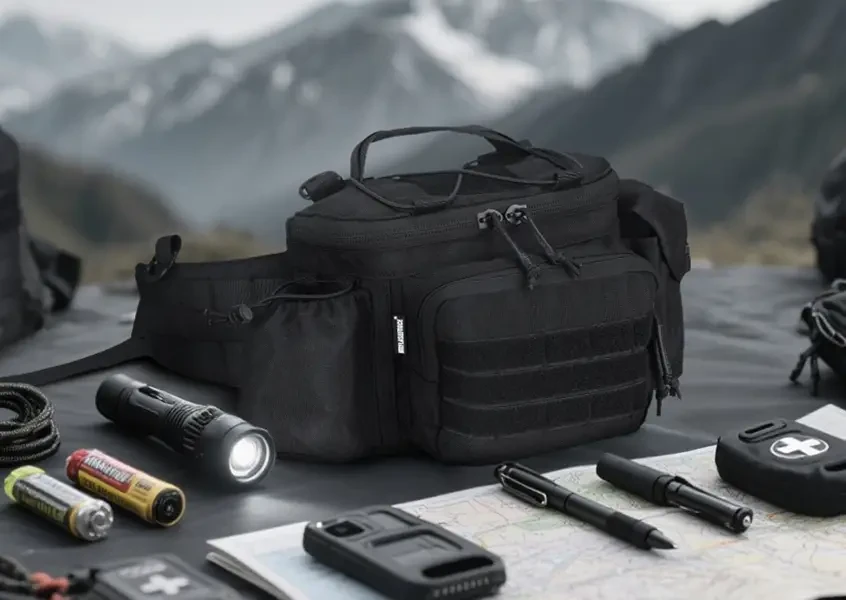
A tactical waist bag offers a practical middle ground between carrying everything in your pockets and wearing a full-size backpack.
It keeps frequently used gear within easy reach while leaving your shoulders and hands relatively free. Depending on its size and design, a tactical waist bag can carry everyday essentials, outdoor accessories, small tools, hydration items, cycling gear or training equipment.
However, tactical waist bags come in several different styles. A compact EDC waist pack and a large belt rig with a shoulder harness may both be described as tactical waist bags, but they are designed for very different load sizes and activities.
In this guide, we will explain the most common types of tactical waist bags, the features that matter most and how to choose a model that fits your intended use.
What Is a Tactical Waist Bag?
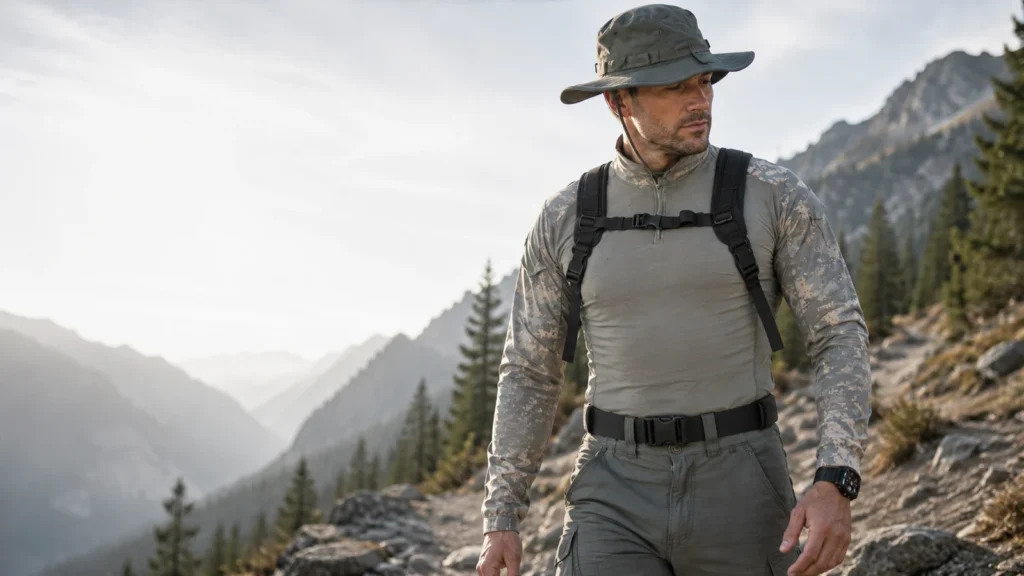
A tactical waist bag is a compact load-carrying bag designed to be worn around the waist, hips or lower back. It is also commonly called a tactical fanny pack, tactical belt bag, military waist pack or tactical lumbar pack.
Compared with a standard fashion waist bag, tactical models typically focus more on:
- Durable materials
- Organized compartments
- Secure zippers and buckles
- Adjustable straps
- External attachment points
- Stable positioning during movement
- Fast access to frequently used items
Some models are minimalist and intended only for a phone, wallet and keys. Others use larger compartments, MOLLE webbing, side pockets and additional shoulder straps to support more demanding outdoor use.
Understanding these differences is the first step toward choosing the right tactical waist bag.
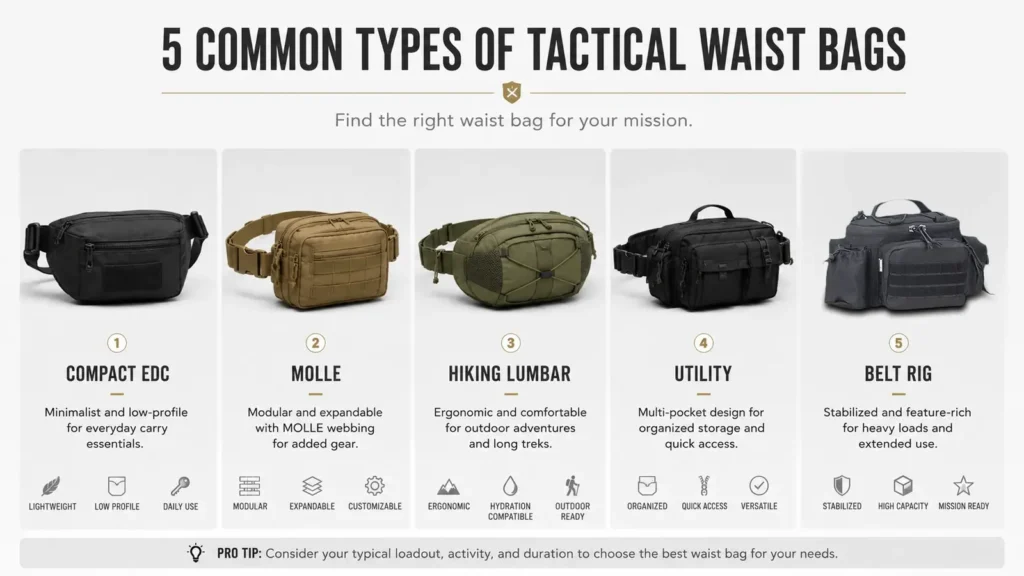
Common Types of Tactical Waist Bags
1. Compact EDC Tactical Waist Bags
Compact EDC waist bags are designed for everyday essentials. They normally have a low-profile shape and one or two main compartments.
Common items carried in this type of bag include:
- Smartphone
- Wallet
- Keys
- Small flashlight
- Charging cable
- Power bank
- Multitool
- Notebook
- Personal care items
The main advantage of a compact EDC waist bag is convenience. It is lighter and less bulky than a backpack and can be worn around the waist or across the body.
This style is suitable for commuting, walking, travel and daily errands. However, its limited capacity makes it less suitable for users who need to carry water, larger tools, outdoor accessories or additional clothing.
2. MOLLE Tactical Waist Bags
MOLLE tactical waist bags include rows of external webbing that allow compatible pouches and accessories to be attached to the outside of the bag.
This modular design lets users adjust their setup for different activities. For example, a user may attach a small utility pouch, accessory holder or additional organizer instead of replacing the entire bag.
MOLLE waist bags are often used for:
- Outdoor training
- Hiking
- Camping
- Airsoft
- Range organization
- Equipment storage
- Utility work
The main benefit is flexibility. The main disadvantage is that adding too many external pouches can make the bag wider, heavier and less stable. A good MOLLE setup should remain balanced and should not interfere with natural movement.
3. Hiking and Outdoor Lumbar Packs
Outdoor lumbar packs are designed to sit around the hips or lower back. They usually provide more carrying capacity than a standard fanny pack while remaining smaller than a daypack.
Many hiking-oriented models include:
- Padded back panels
- Wide waist straps
- Water bottle pockets
- Compression cords
- Multiple organizer compartments
- Breathable mesh
- Reinforced construction
This type of tactical waist bag works well for short hikes, nature walks, cycling trips and other activities where quick access to water and small equipment is important.
Because the load sits near the hips, a properly adjusted lumbar pack can feel more stable than a loose shoulder bag. However, comfort still depends on correct packing and strap adjustment.
4. Tactical Utility and Tool Waist Bags
Utility waist bags focus on organizing small equipment and work accessories. They often include several external pockets, internal dividers and reinforced attachment points.
They may be useful for carrying:
- Hand tools
- Measuring equipment
- Gloves
- Cables
- Repair accessories
- Flashlights
- Small electronic devices
These bags are particularly useful when the wearer needs frequent access to equipment without repeatedly removing a backpack.
When choosing a utility waist bag, compartment design is usually more important than total capacity. A large open compartment may hold more items, but smaller organizer pockets make it easier to locate specific tools.
5. Running and Lightweight Waist Belts
Running waist belts are the smallest and lightest category. They are designed to fit close to the body and reduce movement while running.
They normally carry only a few essentials, such as:
- Phone
- Keys
- Identification
- Cards
- Energy gels
- Small soft flask
Although some running belts use tactical styling, they generally do not provide the same durability, modularity or organization as a full tactical waist bag.
Choose this type when low weight and minimal movement are more important than capacity.
6. Convertible Waist and Sling Bags
Convertible waist bags can be worn around the waist or repositioned as crossbody sling bags.
This design offers more flexibility for urban travel and casual outdoor use. Wearing the bag at the front provides quick access, while wearing it across the body can be more comfortable when sitting or moving through crowded areas.
Convertible bags are convenient, but the single shoulder strap may become uncomfortable when the bag is heavily loaded. Larger models need additional stabilization to prevent swinging during hiking or cycling.
7. Tactical Belt Rigs with Shoulder Harnesses
A tactical belt rig combines a waist bag with an additional shoulder harness. This design distributes part of the load across the shoulders while the waist belt keeps the bag close to the body.
It is particularly useful when a waist bag is larger than a normal fanny pack or when the user needs greater stability during movement.
Compared with a waist-only design, a harness-supported belt rig can offer:
- Better load distribution
- Reduced downward pressure on the waist
- Improved stability
- Less bouncing while walking
- Greater support for larger loads
- Multiple wearing configurations
This style works well for hiking, fishing, cycling, outdoor photography, equipment organization and extended walks.
Tactical Waist Bag vs. Backpack
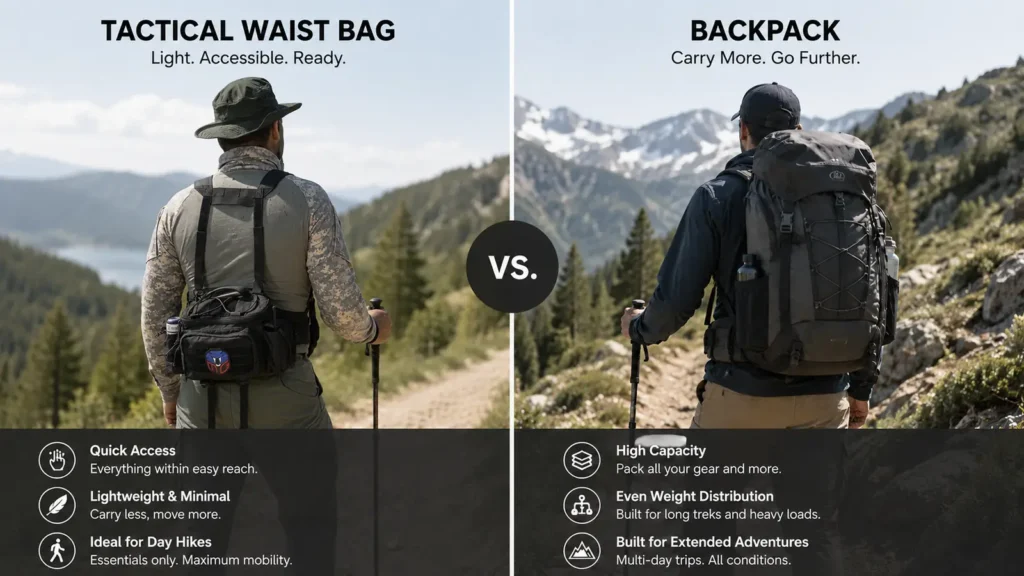
A tactical waist bag is not always a replacement for a backpack. The better choice depends on how much equipment you need to carry.
Choose a tactical waist bag when:
- You need quick access to your gear
- You are carrying a relatively compact load
- You want to keep your upper back uncovered
- You do not need extra clothing or large equipment
- You are taking a short hike or day trip
- You want a secondary bag for frequently used items
Choose a backpack when:
- You need to carry several liters of water
- You are packing extra clothing
- You need space for food or larger outdoor equipment
- You are planning an overnight trip
- Your total load is too heavy for comfortable waist carry
Some users combine both systems. A backpack can carry the main load, while a small waist bag keeps a phone, map, snacks and other frequently used items accessible.
How to Choose a Tactical Waist Bag
Consider Your Intended Use
Start by identifying the main activity.
An EDC user may prioritize a compact shape and discreet appearance. A hiker may need a water bottle pocket and breathable back panel. A cyclist may care most about stability, while a utility user may need MOLLE webbing and organized compartments.
Avoid choosing a bag only because it has the largest capacity or the greatest number of pockets. The right bag should match the equipment you actually carry.
Choose the Right Capacity
A small bag is convenient, but overpacking it can strain the zipper and create an uncomfortable shape.
A large waist bag provides more flexibility, but it may feel bulky when only carrying a few items.
Before purchasing, place your usual equipment together and estimate how much space it requires. Remember that organized compartments can make a medium-size bag more useful than a larger bag with one open compartment.
Check the Internal Organization
Internal organization helps prevent equipment from collecting at the bottom of the bag.
Useful features may include:
- Mesh dividers
- Zippered pockets
- Elastic organizers
- Hook-and-loop panels
- Separate front compartments
- Key attachment points
If you carry cables, tools or small accessories, internal organization should be one of your main priorities.
Look for a Stable Carry System
A waist bag should remain close to the body without feeling excessively tight.
For lightweight loads, a standard adjustable waist strap may be enough. For larger loads, look for a wider belt, padded contact areas or an additional shoulder harness.
A stable carry system is especially important for hiking, cycling and other activities involving repeated movement.
Evaluate the Material
Tactical waist bags are commonly made from durable synthetic fabrics such as nylon or polyester.
Fabric thickness is only one part of durability. Also examine:
- Stitching around stress points
- Zipper construction
- Buckle quality
- Strap attachment points
- Edge binding
- Internal lining
- Reinforcement around pockets
A durable outer material is less useful when the zipper, buckle or stitching is poorly constructed.
Check External Storage
External pockets make frequently used equipment easier to reach.
Depending on your needs, useful external features may include:
- Water bottle pockets
- Flap pockets
- Elastic cord systems
- MOLLE webbing
- Hook-and-loop patch panels
- Compression straps
External storage should remain secure and should not allow equipment to swing or fall out during movement.
Make Sure the Waist Range Fits
Always check the manufacturer’s waist adjustment range.
Measure around the position where you expect to wear the bag. This may be around your natural waist, hips or over an outer layer.
A belt that is too short will be uncomfortable, while excessive unused strap length may need to be secured with elastic keepers or strap management loops.
A Versatile Option: MGFLASHFORCE Tactical Waist Bag Belt Rig JQ-103
Users who need more capacity and stability than a standard fanny pack may benefit from a harness-supported belt rig.
The MGFLASHFORCE Tactical Waist Bag Belt Rig JQ-103 combines the storage layout of a tactical waist bag with a removable shoulder harness and an adjustable waist belt.
It is constructed from 1000D nylon and has a main bag size of approximately 10 × 4.9 × 7 inches, or 25.5 × 12.5 × 18 centimeters. The adjustable waist system fits approximately 28 to 55 inches, or 71 to 140 centimeters.
This makes it suitable for users who want a larger tactical waist bag without moving to a full backpack.
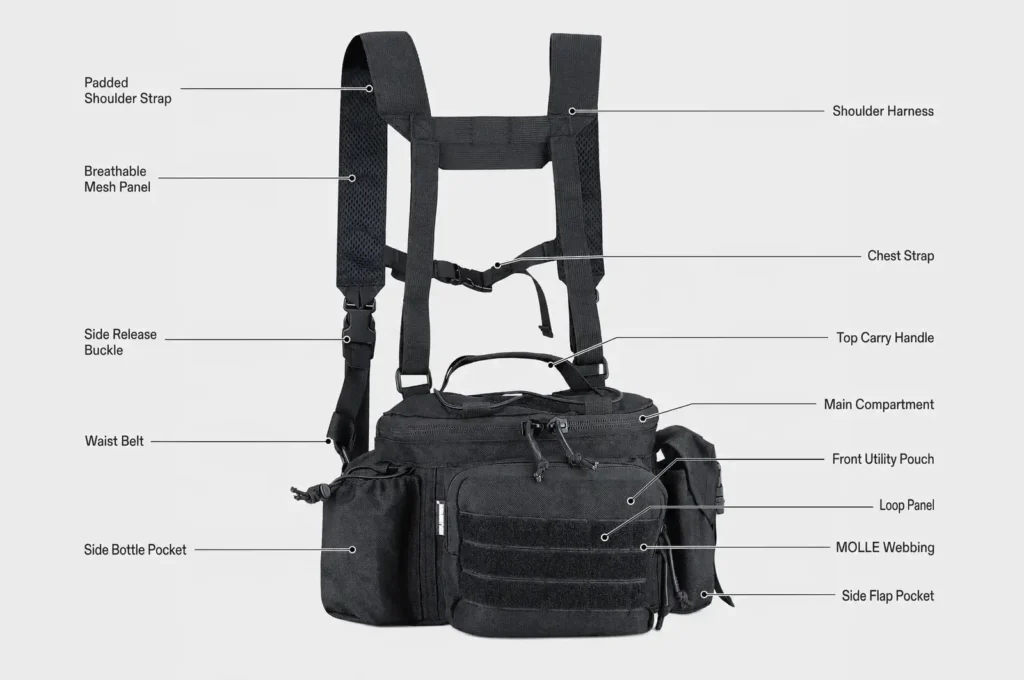
Key Features of the JQ-103 Tactical Waist Bag
Removable Shoulder Harness
The shoulder harness helps distribute the load and stabilize the bag during active use.
It can be useful when the main compartment is carrying more than a standard lightweight waist pack. Because the harness is removable, the user can adjust the carrying configuration according to the activity and load.
Stowable Waist Belt
The adjustable waist belt can be used to secure the bag around the hips or waist. When the belt is not required, it can be stored to create a cleaner alternative carry setup.
This feature gives the JQ-103 more versatility than a conventional fixed waist bag.
Practical Main Compartment
The main compartment provides space for everyday essentials, outdoor equipment, small tools and training accessories.
A zippered mesh divider helps separate smaller items, while the internal loop panel provides additional organization options.
Front Utility Pouch
The fixed front utility pouch provides quicker access to smaller items that might otherwise become difficult to locate inside the main compartment.
It can be used for frequently accessed equipment such as cables, compact tools, a notebook or personal accessories.
MOLLE Webbing
Standard MOLLE webbing allows compatible external accessories to be attached to the bag.
This gives users the option to customize the setup while keeping the main storage compartments organized.
Side Water Bottle Pocket
A dedicated side pocket provides an accessible position for a water bottle or similarly shaped item.
This is particularly helpful during hiking, walking, fishing and outdoor trips where hydration needs to remain easy to reach.
Side Buckle Flap Pocket
The opposite side includes a flap pocket secured with a buckle. It can hold items that benefit from a separate external compartment.
Using different side-pocket designs also helps organize equipment by shape and frequency of use.
External Elastic Cord System
The elastic cord system provides additional external carrying flexibility for lightweight items.
It may be useful for temporarily securing gloves, a compact layer or another item that does not need to be placed inside the main compartment.
Padded Breathable Back Panel
The rear panel is padded and designed to improve comfort where the bag contacts the body.
A breathable contact surface is especially useful during longer walks or warm-weather outdoor activities.
Hook-and-Loop Patch Area
The front hook-and-loop area can be used for compatible identification or decorative patches.
The patch field measures approximately 7.5 × 3 inches, or 19 × 7.5 centimeters.
Who Is the JQ-103 Best For?
The JQ-103 may be a practical choice for:
- Day hikers
- Campers
- Cyclists
- Anglers
- Outdoor photographers
- Range users
- Airsoft players
- Utility workers
- Travelers
- EDC users who carry more than basic pocket items
It is especially relevant for users who find a normal tactical fanny pack too small but do not want to carry a full-size tactical backpack.
What Can You Carry in the JQ-103?
The exact load depends on the size and shape of each item, but a practical setup may include:
- Smartphone
- Wallet and keys
- Power bank and charging cable
- Flashlight
- Multitool
- Compact first-aid supplies
- Gloves
- Notebook and pen
- Small camera accessories
- Outdoor snacks
- Water bottle
- Navigation accessories
- Small repair tools
Avoid filling every compartment simply because space is available. A balanced load will be more comfortable and easier to organize.
Place heavier items close to the padded rear panel. Frequently used items should be stored in the front or side compartments, while smaller loose accessories can be placed in internal organizer sections.
How to Wear a Tactical Belt Rig Correctly
Start by positioning the main bag around the lower back or hips. Tighten the waist belt until the bag feels secure without restricting breathing or movement.
Next, adjust the shoulder harness so that it supports part of the load without pulling the bag upward. The waist belt should still provide most of the stabilization.
After adjustment, walk, bend and rotate your upper body. The bag should remain close to the body and should not swing excessively.
When carrying an uneven load, redistribute the contents instead of tightening one strap excessively. Proper weight distribution usually improves comfort more effectively than overtightening the carry system.
How to Maintain a Tactical Waist Bag
Regular maintenance can help preserve the material, zippers and straps.
After outdoor use:
- Empty all compartments
- Remove loose dirt with a soft brush
- Wipe the surface with a damp cloth
- Clean zippers carefully
- Allow the bag to air-dry completely
- Avoid storing it while wet
- Inspect buckles and stitching
- Remove unnecessary accessories before storage
Avoid using harsh cleaning chemicals unless they are specifically recommended for the material. Excessive heat can also damage synthetic fabric, padding and plastic hardware.
Final Thoughts
The best tactical waist bag is not necessarily the largest or most complicated model. It is the one that provides the right balance of capacity, organization, stability and comfort for your activity.
Compact EDC bags work well for daily essentials. MOLLE waist bags provide modular expansion. Hiking lumbar packs prioritize comfort and hydration, while harness-supported belt rigs offer greater stability for larger loads.
For users who need more storage than a standard tactical fanny pack but want a lighter and more accessible alternative to a backpack, the MGFLASHFORCE Tactical Waist Bag Belt Rig JQ-103 provides a versatile combination of organized storage, external attachment options and multiple carry modes.